
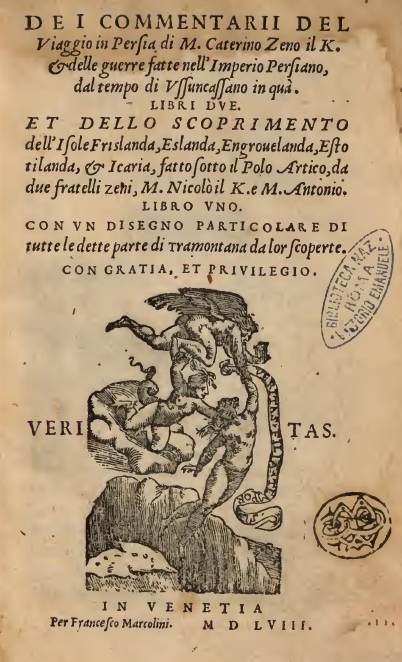
The Zeno brothers’ voyage is a purported 14th-century expedition led by Nicolò and Antonio Zeno, Venetian navigators. According to a narrative published in the 16th century by their descendant, Nicolò Zeno the Younger, the brothers embarked on a journey to the North Atlantic around 1380. They allegedly traveled to a series of islands, including Frisland, Icaria, and Estotiland, encountering various cultures and documenting their experiences.
The story claims that Nicolò first reached Frisland, where he served a prince named Zichmni. Later joined by his brother Antonio, they purportedly ventured further, mapping regions that might correlate with parts of modern-day Greenland and the Canadian coast. These accounts, if true, would predate Columbus’s discovery of the New World by over a century.
In 1558, Nicolò Zeno the Younger published “De i commentarii del viaggio in Persia di m. Caterino Zeno,” which included letters and a map allegedly drawn by his ancestors. The Zeno map depicts the North Atlantic and features islands such as Frisland and Estotiland, which do not appear on any other maps from that era.
However, the authenticity of the Zeno brothers’ voyage is highly disputed. Modern historians and scholars have found no concrete evidence supporting the existence of the islands mentioned in their accounts. The maps and letters published by Zeno the Younger are considered by many to be a mixture of myth, misinterpretation, and possible fabrication. Critics argue that the voyage likely never occurred, viewing it as a compelling yet unsubstantiated tale from the age of exploration.
 Trail of the Green Man