
At the heart of this mystical fraternity is the figure of Christian Rosenkreuz (CRC), a fusion of alchemy, mysticism, and philosophy. CRC, whether mythical or symbolic, is revered as the founder of the order, imparting profound spiritual wisdom.

The life story of christian rosenkreuz
The mysterious C.R. was said to have been born in the year 1378 (which is also when the
Great Schism of the Catholic Church saw two popes in rivalry with each
other, according to Tobias Churton).
He is described as the last surviving descendant of a German noble family from Hesse who were killed because of their belief in Cathar (i.e. gnostic Christian) doctrines. At the age of five, he was rescued by an Albegensian monk from the Languedoc region (a well-known Cathar stronghold before the Albigensian Crusade of 1208), who brought him up in a monastery. Later he would form the Rosicrucian Order, along with four brothers from the same priory.
However, like Jesus and many other mythological sages, he is then said to have gone on pilgrimages to various cities in the ancient world and studied there under an assortment of wise masters, before returning to Europe to found the Domus Sancti Spiritus (House of the Holy Spirit).
According to the American Rosicrucian Society:
The Fama tells the story of “Father C.R.” or, the mythical Alchemist, Christian Rosenkreuz‘s ill-fated pilgrimage to Jerusalem; his subsequent tutelage by the secret sages of the east, the wise men of Damcar in Arabia, from whom he learned the ancient esoteric knowledge which included the study of physics, mathematics, magic and kabbalah; his return through Egypt and Fes and his presence among the alumbrados in Spain. It is thought in occultism that Rosenkreuz’s pilgrimage seems to refer to transmutation steps of the Great Work.
The FOUNDING OF AN ORDER
After his arrival back in Germany from his travels, Father C. is said to have recruited eight loyal brethren to create a circle of nine members to form an esoteric Christian society: “The Fraternity of the Rose Cross.”
Each of these members were then sent out to travel the world. Their mission: to learn the secrets of various religious traditions and healing cultures, thus building up a storehouse of universal wisdom and knowledge upon which to draw upon in order to do good works. They were instructed to make their first priority to acquire knowledge of how to “cure the sick” free of charge (a very Paracelsian idea).
According to the FAMA, the brothers drew up an agreement with six articles prior to their separation, vowing to one another:
- That none of them should profess any other thing than to cure the sick, and to do so, gratis.
- None should be constrained to wear one kind of habit, but instead follow the custom of the country.
- Every year, they should meet together at the house Santi Spiritus, or write the cause of their absence.
- Every Brother should seek a worthy person to succeed him after his death.
- The abbreviation, CR, should be their seal, mark, and character.
- The Fraternity should remain secret for one hundred years.
The Seven-sided Tomb of Father C.R.C.
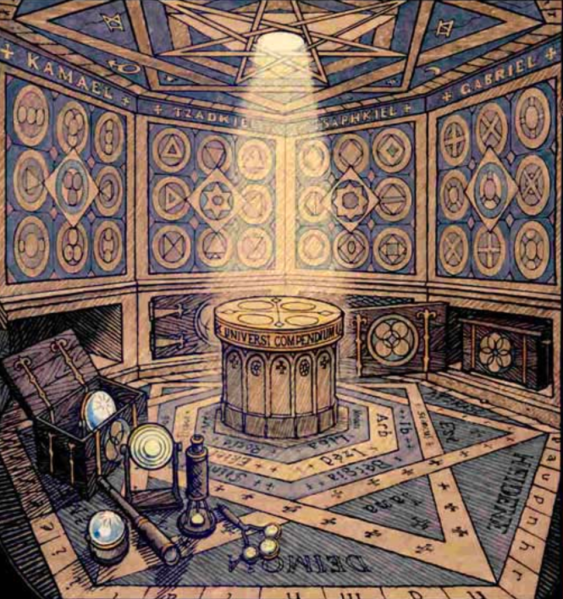
Central to Rosicrucian lore is the enigmatic seven-sided tomb of Christian Rosenkreuz, as revealed in the Fama Fraternitatis. Father C.R. is said to lived until he was 106 (dying circa 1484) when he was interred in a seven-sided tomb whose walls were covered in magical icons and talismans and lit by a lamp that shone like the sun. It is not lost on many that 106 is reduced to the number 7 in numerology…
According to legend, this crypt was discovered posthumously, and housed the remains of the founder, surrounded by profound symbols and teachings. The seven-sided structure, symbolically rich in the context of alchemy and mysticism, is thought to represent spiritual perfection and the quest for enlightenment, mirroring as it does the steps of initiation found in many other traditions, including alchemy.
We are also told some critical details about the architecture and contents of Brother CRC’s tomb:
- It is heptagon-shaped, or has seven sides, similar to the famous Seal of God drawn by John Dee
- The tomb is said to be lit by a lamp that shines like an “inner sun,” which was situated in the upper part in the centre of the ceiling, like a dome
- At its centre was a vault with a round altar housing the preserved body of C.R. (perhaps in the style of an Egyptian mummy?) which was discovered holding a parchment book, simply referred to as I, which contained a letter signed by his 8 disciples.
- Each of the seven sides of the wall was said to measure five
 x eight (h) foot; and be covered in 10 symbols contained within 10 squares
 - The altar was said to be covered over with a plate of brass and engraved with an inscription which read: A.C. R.C. Hoc universi compendium vivus mihi sepulchrum feci. [This compendium of the universe I made in my lifetime to be my tomb.]
- Round about the first Circle was carved the words: Jesus mihi omnia. [Jesus, everything to me]
- In the middle of the altar four figures, enclosed in circles, whose circumscription was:
1. Nequaquam vacuum. [a vacuum exists nowhere.] 2. Legis Jugum. [The Yoke of the Law.] 3. Libertas Evangelii. [The Liberty of the Gospel.]; 4. Dei gloria intacta. [The whole glory of God.] - The ceiling was said to be divided into triangles ‘running from the seven sides to the bright light in the centre.’
- The floor was also said to be divided into triangles and inscribed with the names of the ‘inferior’ governors (i.e. the fixed stars), which some think might be similar to the Sigil of God made by the magician and practitioner of angelic magic, Dr John Dee.
1604 – a kEY yEAR
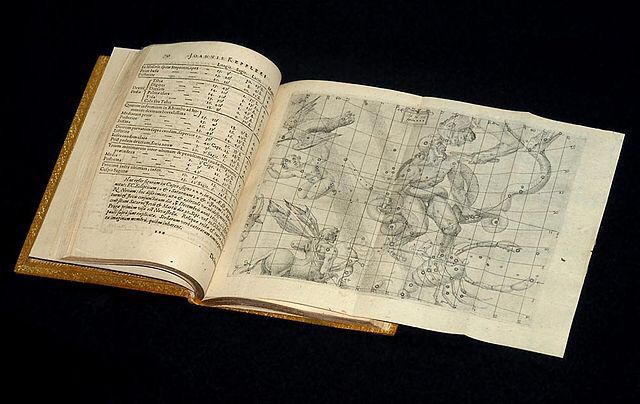
Like the Tomb of Alexander the Great, it was supposedly lost to posterity for 120 years before being rediscovered when illuminated by an ‘artificial sun’ which some interpret to be the so-called ‘mock star’ of 1604, aka Kepler’s Supernova, which appeared in the sky, shining brightly from the constellation of Serpentarius (aka Ophiuchus, the serpent bearer which is often associated with the mythical hermetic healer, Asclepius).
Kepler’s supernova formed part of a double celestial ‘sign’ that also included the so-called Great Conjunction of Jupiter and Saturn, the stars of faith and reason, in 1603. These astronomical events recurs every 20 years or so, and many astrologers, like Kepler, believed it might also explain the Star of Bethlehem that signalled Jesus’s birth to the Magi.
Unsurprisingly, in the Confessio fraternitatis, this ‘new star’ is described as a divine sign or seal (Confessio fraternitatis, 1615a: 71–73) and this is certainly the way that the astrological events of 1603-4, were viewed by many, including one of England’s most famous astrologers, William Lilly. More on this later.
 Trail of the Green Man