

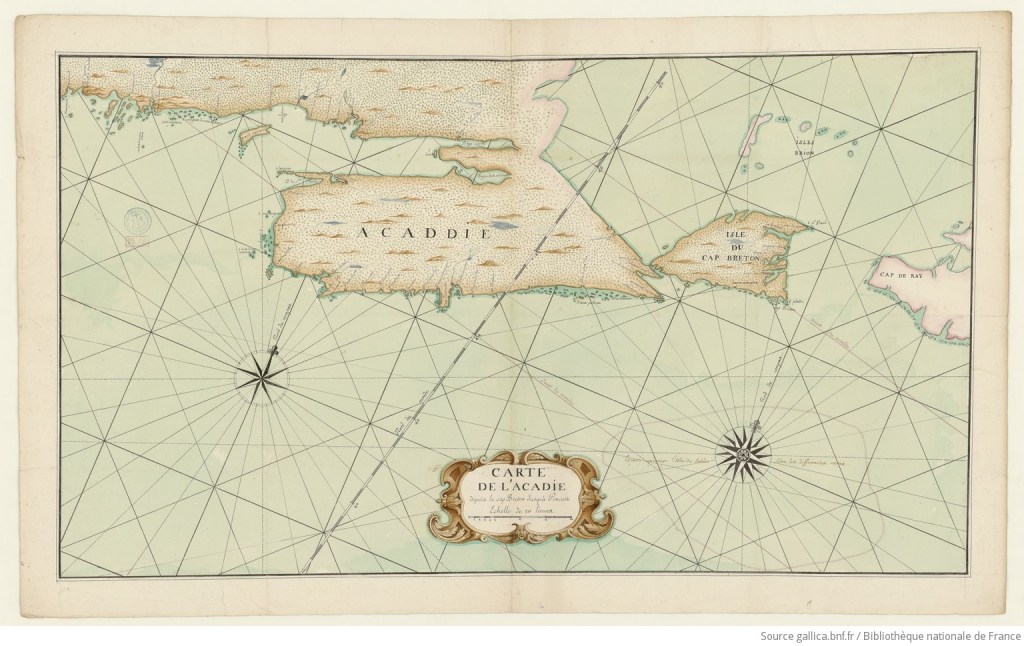
Many people may not know this, but an historical settlement area located around the regions of what would become Quebec, the Maritime provinces, and what is now the American state of Maine, once existed and was named Acadia, after the mythical paradise of Arcadia. At one time, the region had its own language – a dialect of French – as well as its own flag, customs and culture, some of which was influenced by its original Indigenous inhabitants, the Mi’kmaqs and the Maliseet.
The colony, which once extended over parts of New Brunswick, Nova Scotia, the Magdalen Islands and Prince Edward Island, as well as American Maine, was founded in 1604 by French settlers from southern Poitou, who arrived under the leadership of Pierre du Gua de Monts and Samuel de Champlain (aka the Father of New France and founder of Quebec) after a series of exploratory trips in 1534 undertaken by the French explorer, Jacques Cartier.
The association of this area to the name Acadia has its origins in Italian explorer, Giovanni da Verrazzano’s travels to North America. Between 1524 and 1525, at the behest of the king of France, he explored the Atlantic coast and gave the name Archadia (or Arcadia in Italian) to a region close to the present-day American state of Delaware, explaining his choice to reference the mythical paradise of Arcadia in his diary as being inspired by “the beauty of its trees.” The Portuguese explorer, Estêvão Gomes’ notes from 1524 also included Newfoundland as part of the area he called Arcadie. In 1566, the cartographer Bolongnino Zaltieri also gave a similar name (Larcadia) to an area northeast of present-day Nova Scotia and New Brunswick. By the 1620s, the name Acadia was commonly used for the region of what is now the maritime provinces of Canada.
HuGUENOT CONNECTION?
During the late sixteenth and early seventeenth centuries, Poitou was a hotbed of Huguenot (French Calvinist Protestant) activity among the nobility and bourgeoisie. The Protestants were discriminated against and brutally attacked during the French Wars of Religion (1562–1598). It is unclear whether the settlers from this region were protestant or catholic, however, it is possible that one of their motivations for emigrating was to start a new life, away from the horrors and disruption of religious conflict. Interestingly, however, the first 80-odd colonists settled on an island in the St Croix River called Île Sainte-Croix, which is French for Holy Cross. A nod to the rosy cross, perhaps?
It may be telling that the founder of this settlement, De Monts, was a former Huguenot who had fought in the French Wars of Religion, but had later converted from Protestantism to Catholicism to maintain the patronage of the French crown. Were he and the first wave of French settlers trying to create a utopian community in the New World?
A recent discovery of a possible birth certificate for Samuel de Champlain also suggests that he may have been born a protestant. The name Samuel comes from the Old Testament adds weight to this idea. Like De Monts, Champlain also fought in the Wars of Religion, so may have been affected by what he saw during that time. However, by the time he undertook his voyages of discovery and exploration to Canada, he had definitely converted to Catholicism.
Unfortunately, but perhaps with a nod to Poussin’s message about trouble in paradise, the region of Acadia was beset by conflict. In 1621, the local government renamed Acadia to Nova Scotia and, in 1629, allowed the Scottish settlers of Sir William Alexander to move in. Alexander’s project of Scottish expansion was cut short in 1632 by the Treaty of Saint-Germain-en-Laye, which allowed France to regain Acadia. Later, the area was taken over in the 18th century by the English, (after their 1763 victory in the Seven Years’ War) and many of the original Acadians were forced to relocate.

The historical region of Acadia also includes the location of the mythical Oak Island, a privately owned island in Lunenburg County on the south shore of Nova Scotia, Canada that has become synonymous with treasure hunting, templar lore and a major TV series. It is one of several islands in Mahone Bay, which is located in the southeastern coast of Nova Scotia, which falls within the boundaries of the historical Acadia.
 Trail of the Green Man