
One of the factors that appears to unite many of the very different people who appear to have been Rosicrucians, or Rosicrucian sympathisers, is a strong sense of idealism and attachment to utopian ideologies. Almost every person, whether scientist or magus, politician or playwright, seems to have held onto the dream that the future could look better than the past, that society’s ills had the potential to be cured, and in many cases, seemed willing to conspire with (or inspire) those changemakers who were in a position to make such visions a reality.
Often, these hopes and idealistic dreams for a better future were centred around a symbol or metaphor. One of the most popular and enduring of these during the Reformation and Renaissance periods, was the myth of Arcadia.
The notion of Arcadia is a complex and multifaceted concept that has been used in various ways throughout history. It often represents an idyllic, pastoral paradise, associated with peace, simplicity and harmony with nature. In ancient Greece, the name Arcadia referred to a Peloponnesian plain that was thought of as a sort of earthly nirvana similar to the biblical Garden of Eden.
This concept has been explored by scholars and philosophers in different contexts, including the Protestant Utopian movement, Francis Bacon’s New Atlantis, and Nicolas Poussin’s painting Et in Arcadia ego.
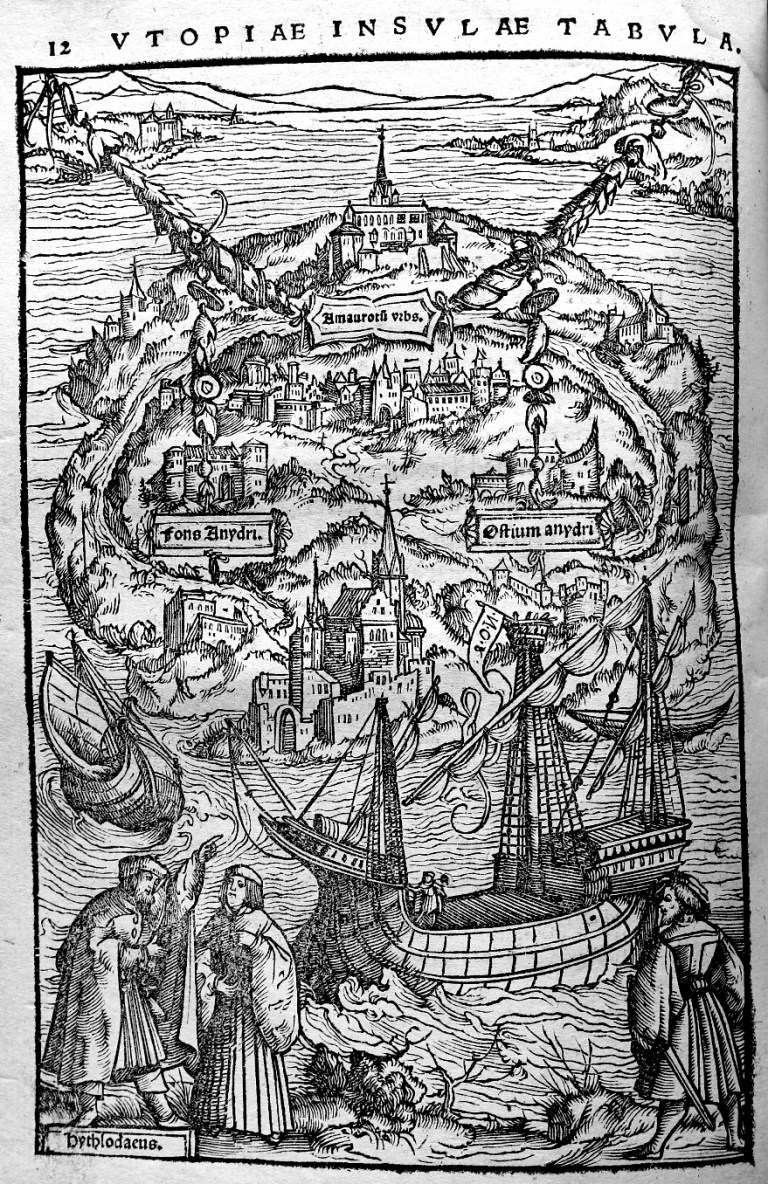
Closely related to Arcadia is the concept of Utopianism, derived from a book named Utopia written by Thomas More in 1516. in a nutshell, Utopia can be defined as ‘a state of visionary schemes for producing perfection in social or political conditions for the betterment of all.’ According to one scholar, ‘A Utopian society is basically a society, which has surpassed aggression, war, hate, and crime while establishing “peaceful” and orderly communities.’
While the notion of Arcadia/Utopia has become a symbol of an ideal society or state of existence, the interpretation of this ideal varies, reflecting different visions of what constitutes a perfect world. These have been explored in various ways over the centuries, from artworks and plays (Poussin and Shakespeare), to philosophical dialogues and treatises (Plato, More, Bacon) to religious idealism, as embodied in Protestant Utopianism and Rosicrucianism.
Let’s examine some of those pertinent to our story in more detail.
ART & THEATRE
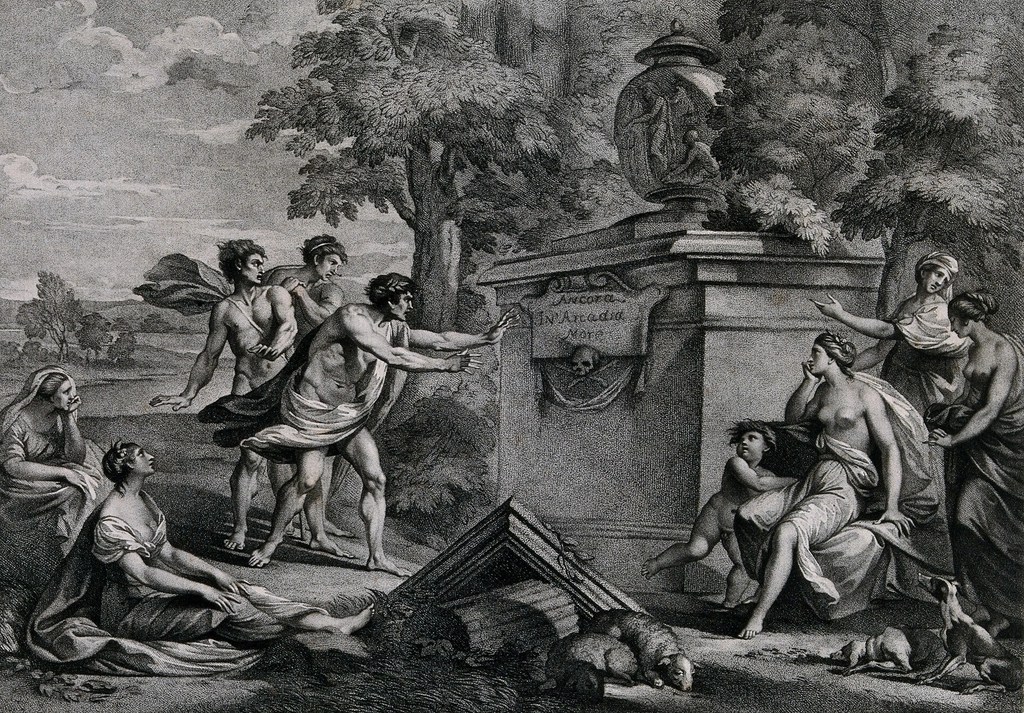
Poussin’s Shepherds of Arcadia (1637)

The Shepherds of Arcadia, one of Poussin’s seminal works, has long fascinated art historians and enthusiasts alike. Completed in 1637-1638, the painting depicts a pastoral scene set in the idyllic landscape of Arcadia, with shepherds gathered around a tomb. The tomb is thought to have been inscribed with the Latin inscription Et in Arcadia ego, which translates to “I too am in Arcadia” – the name of the painting. The mysterious nature of this phrase has fuelled countless interpretations, with some suggesting it conceals an esoteric knowledge or a hidden truth. The tranquillity of the setting takes on an air of mystery when one contemplates the intriguing possibility that Poussin may have been privy to a secret akin to the enigmatic seven-sided tomb associated with Christian Rosenkreutz (CRC).
It is also, however, a reminder that even in paradise, one cannot escape death. Indeed, many people do not realise that symbol of the tomb, together with the phrase “Et in Arcadia ego” (“Even in Arcadia, I exist”) is actually meant to suggest the presence of death – even in an idyllic place like Arcadia. In this sense, the painting is often interpreted by art critics and scholars as a memento mori (Latin for “Remember that you will die”) a reminder of the inevitability of death. We see this more clearly in an earlier version of the concept painted in circa 1618 by Guercino.

This concept was often used in art and literature, especially in the Middle Ages, as a reminder of the inevitability of death and the need to live a virtuous life. It was also a common theme in many initiatic traditions and mystery religions where the transformation of the initate is seen as a rebirth of sorts, often one that enables him/her to transcend death, or in some instances, to overcome the restraints of the ego and conventional ways of thinking. Hence the phrase, ‘He who dies before he dies, does not die when he dies.’
Shakespeare’s The Tempest

Some scholars have characterised Shakespeare’s play, The Tempest, first performed at Court for his patron, King James, circa 1611 and published in 1623, as a utopian vision, in which the remote island he sets it on serves as a kind of pristine paradise where the magician, Prospero, who is a nod to Plato’s archetype of the philosopher-king, can exercise his magic without reservation and different social orders can be imagined. He uses the character of Gonzalo to envisage how this utopian society, free from enslaved labour and hierarchy, might work. However, the play also explores the limitations and contradictions of this utopian vision, so that his audience can also see the potential problems that can arise within such a framework.
Such ideas are embodied in Sir Thomas More’s seminal text Utopia (1516), which describes life on a fictional island in the New World, similar to Bacon’s New Atlantis. Both of these pay homage to Plato’s account of the mythical island of Atlantis. Perhaps this is where Shakespeare got his inspiration for The Tempest from?
In fact, Shakespeare’s plays often contain utopian elements, allowing the playwright and his audience to a nuanced exploration of these ideals, acknowledging the complexities and contradictions inherent in any vision of a perfect society. These include:
- As You Like It: In As You Like It, the Forest of Arden serves as a utopian space where characters can explore different ways of living and where the usual social hierarchies are suspended1. However, the play also presents a critique of utopian ideals, exploring the tension between the individual’s desires and the needs of the community.
- A Midsummer Night’s Dream: In A Midsummer Night’s Dream, the forest outside Athens is a place of enchantment and transformation, where societal norms are overturned and a kind of utopian freedom is possible. However, the play also acknowledges the darker, more chaotic aspects of this freedom.
- Political Utopias: In plays like Julius Caesar and Coriolanus, Shakespeare explores political utopias and the idea of the perfect ruler. However, these utopian visions are often shown to be unattainable or flawed.
This was probably because he knew how important drama was to the realm as a form of propaganda, but also because, at the height of his career, both Elizabeth I and James became patrons of his theatre company, and he knew that such themes would be of interest to his illustrious benefactors.
It may also worth be significant that the central figure of Prospero in The Tempest is a white magician who uses his magic for justice. Some think the Prospero character was based on John Dee, Queen Elizabeth’s favourite magus and spy. By contrast, Shakespeare’s second royal patron, King James I, had a morbid and fearful interest in black magic and witchcraft. In fact, he published a treatise on the subject in 1597. Themes that Shakespeare explores more fully in his play, Macbeth (1606/7), which was written and performed for King James soon after he ascended the throne. Some have speculated that James’ superstitious obsession with the supernatural led to some of the most brutal witch hunts in history, particularly after he made witchcraft an act punishable by death in 1604 .
This naturally leads us on to Rosicrucianism and religious forms of utopianism.
RELIGIOUS MOVEMENTS
The forms of utopia most relevant to our quest centres around religious and philosophical movements. Rosicrucianism was ‘born’ against the backdrop of two forms of these more than any other: the utopianism that motivated many protestants during the Reformation, and the apocalypticism that arose out of the tumult of this period, which drove many to believe that the world was on the cusp of a golden age, along he lines of the prophecies of the biblical Revelations.

Protestant Utopianism
One of the driving forces of the Reformation was the utopian vision in Protestant thought of creating an ideal society based on Christian humanistic principles – the universal brotherhood of man, compassion for your fellow ‘sinners,’ doing right by your neighbours, and forgiveness and social tolerance. In some cases, this vision was infused with one that harks back to life before the fall of man in Genesis.
The author of the Fama and Confessio, Johannes Andraea, was a Lutheran pastor who would go on to express his own vision of Christian utopianism in a work known as Christianopolis (1619), published four years after the Rosicrucian tracts. In it, he describes the ideal Christian city in fairly Baconian and Platonic terms, as being a society that is constructed upon knowledge that based on mathematical lines, a language the angels share, and Christian-based social morals and ethical principles.
Just a century earlier, we see similar lofty Protestant ideals being mixed with politics in a way that involves merging state and church in people like John Calvin, who did go on to briefly create a Protestant city-state in Swiss Geneva in 1536, and William Cecil, the devout Protestant statesman determined to ensure that his sovereign, Elizabeth I, did not lose her nerve or waver from her father, Henry VIII’s, decision to ‘divorce’ England from Rome and the Catholic Church during the 1530’s.

Apocalypticism, Rosicrucianism & Freemasonry
It is fair to say that revolution was in the air during this period. People were tired of the status quo i.e. the Catholic Church, and were looking forward to the advent of a golden age in which religious sectarianism and the outlawing of freedom of thought/expression, especially with regard to the pursuit of more secular forms of knowledge such as science, would finally end.
Some groups, such as the Theophrastians and Paracelsians, longed for a time when a more gnostic (i.e. individual) form of Christianity (the ‘true faith’) would predominate, and there would be no need for a church to act as an intermediary between man and God. And that any man sincere in his desire for salvation coud attain it if he was a true pilgrim – ideas epitomised in Matthew 7.7: “Ask and ye shall receive; seek and ye shall find; knock and it will be opened to you.”
In fact, many admirers of Rosicrucianism, including men close to the Thuben circle like Adam Haslmayr, believed that such an age was in the process of erupting. He was not alone. The Fama, informed by the rebellious and utopian spirit of the age, together with the apocalypticism of Tobias Hess, encouraged this belief. This notion (and the Rosicrucian movement itself) was further supercharged by the extraordinary set of astrological events of 1603/4, together with the slew of prophecies that followed, all of which seemed to confirm their secret hopes.
SCIENCE, PHILOSOPHY & POLITICS
Bacon’s ‘New Atlantis’
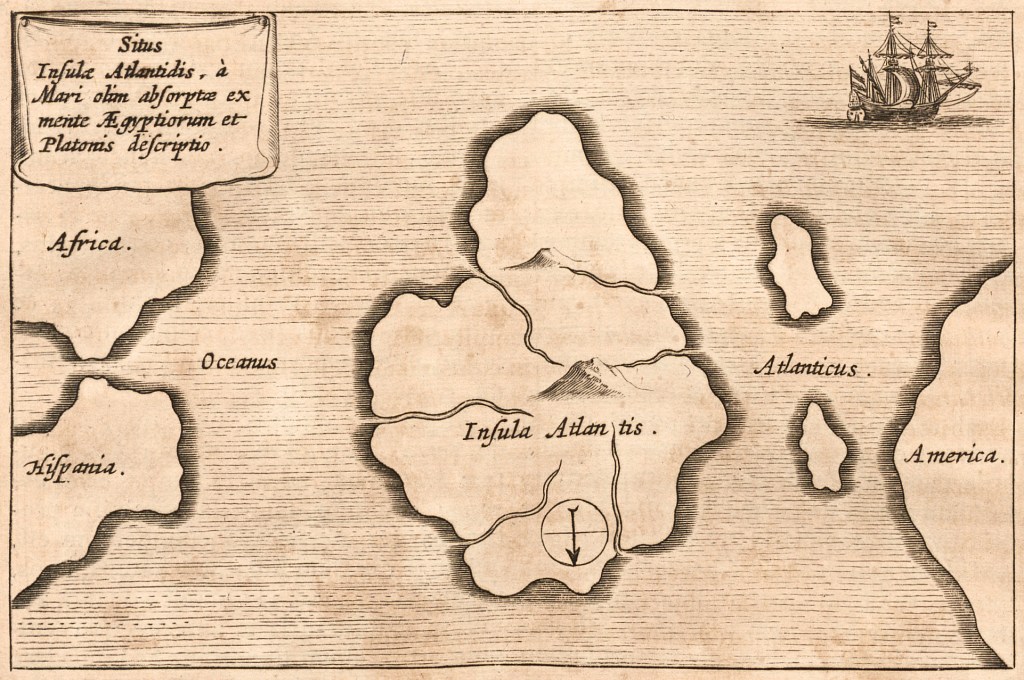
We also see utopian ideas taking a more scholarly and intellectual form in the work of Sir Francis Bacon.
In his book, the New Atlantis, published posthumously in 1626, Bacon portrays a utopian society located in a place called Bensalem (no doubt, a nod to the holy city of Jerusalem). In contrast to the traditional religious and artistic concept of Arcadia as a simple, pastoral paradise, however, Bacon’s utopia is a place of advanced technology and scientific achievement, sharing values and ideals similar to those of the Royal Society, which many believed he inspired. So, rather than a religious polis, this city represents a kind of secular Arcadia, where knowledge and discovery, as well as technological advancement of the kind that benefits humanity, is valued above all, reflecting Bacon’s own interests and sensibilities.
Of course, Bacon’s vision was not unique – it forms part of a long tradition of treatises along a similar trope such as Sir Thomas More’s Utopia and Plato’s Republic. all of these present their particular vision in the form of a dialogue or narrative of an ideal society, often set on an island. All explore themes such as justice, and the role of knowledge, education and wisdom on bettering society.
However, they also differ vastly in terms of their conception of leadership (philosopher-kings vs egalitarian/democratic law) and the role of class structures and religion in society. In fact, many see Bacon’s work as a critique and refutation of Plato’s ideas, especially those concerning the notion of a benign theocracy.
UTOPIA & THE NEW WORLD
In some instances, especially during the Age of Discovery, the notion of utopia often became associated with a particular place. Many of the religious and utopian narratives around Arcadia became focused on America and the New World. We see this, for example, in printed works produced and published by humanist and protestant printers such as Eustache Vignon.
So much so, that many of the navigators who discovered and mapped parts of the North American continent began to refer to parts of north-east coast of Maine and Canada as Arcadia.
In popular travel literature published at the time, the New World was seen as a land of abundance and natural beauty, untouched by the corruption and decadence of the Old World. In this sense, it was the epitome of Arcadia and the hypothetical island paradises created by Shakespeare, Bacon and More .
As a result, many European settlers emigrated to America and Canada, including the Acadians, with the hope of creating a new society based on their ideals. In this sense, these motivations parallels the Protestant utopian movement, which sought to create a society based on Christian principles. In many instances, the people choosing to emigrate came from protestant and puritan backgrounds, perhaps driven simultaneously by the fear of religious persecution they had suffered during the Thirty Year’s War, Spanish Inquisition and English Restoration; as well as the desire to start over and build a life based on the rewards of individual efforts and hard work, rather than the benefits of patronage or as a result of your educational background or class privilege. Ideas that became embedded in the concept of the American Dream.
Of course, as these settlers found out, not everything about the New World was all that rosy. The hardships of a pioneer lifestyle, as well as the horrors of war, environmental destruction and the displacement of indigenous peoples by European colonisers overshadow and in some cases, directly contradict the idyllic image of the New World. These contradictions reflect the tension between the ideal and reality that is also present in the concept of Arcadia.
Indeed, all of these utopian visions are seldom achievable because, for one thing, it demands that everyone agree universally on what that perfect society would look like and how it would work. A virtual impossibility, as we know from the history of humankind, as well as the controversy and enmity that rages within charged subjects like politics and religion.
A Utopian society could not exist with the individuality that nature has bestowed on the human race. As long as humans remain unique in their state of mind, utopia is a mere fantasy. Utopia is a non-existent, but absolutely perfect place, as we can see from the book by Sir Thomas More.
Hidden Utopianism in The Tempest, by Vinisha Varughese (2012)
 Trail of the Green Man