

Johannes Trithemius was a German Benedictine abbot and polymath who played a significant role in the German Renaissance as a lexicographer, chronicler, cryptographer, and occultist. He is often credited as a foundational figure in modern cryptography and steganography, sharing this distinction with Leon Battista Alberti. Additionally, Trithemius is regarded as a pioneer in the fields of bibliography and literary studies.
Trithemius had a profound influence on the development of early modern and modern occultism. His notable students included Heinrich Cornelius Agrippa and Paracelsus, who themselves became prominent figures in the occult and alchemical traditions.
One of Trithemius’ most famous works is “Steganographia,” written around 1499 and published in Frankfurt in 1606. This three-volume book was initially perceived as a treatise on magic, particularly concerning the use of spirits for long-distance communication. However, it was later understood to also contain sophisticated methods of cryptography. “Steganographia” was controversial enough to be placed on the Index Librorum Prohibitorum, the list of prohibited books, in 1609, and remained there until its removal in 1900.
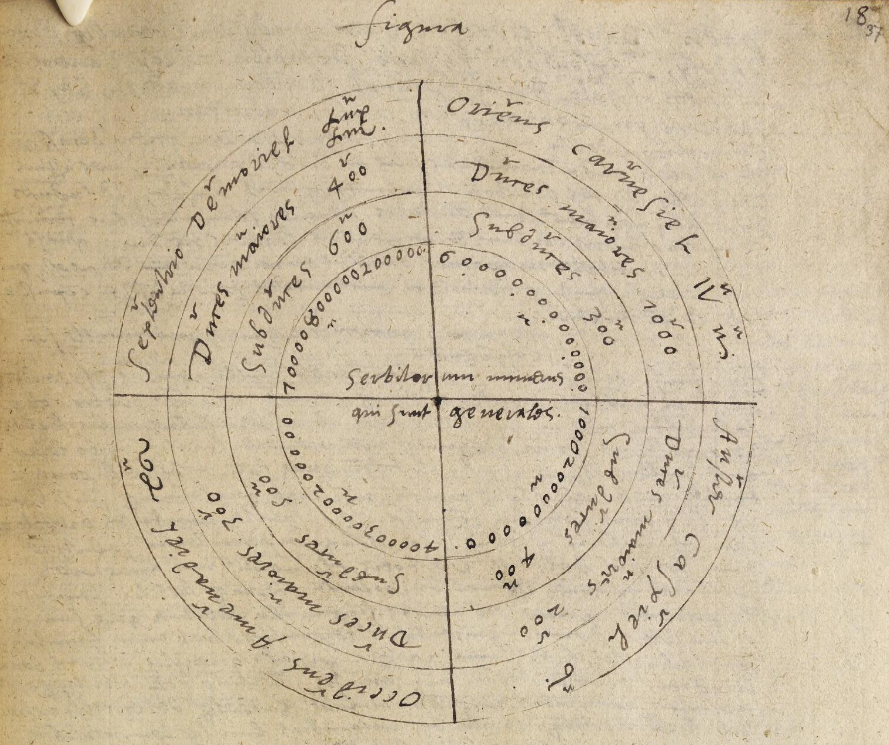
It may be hard for us to imagine now, but during the Reformation, ciphers and codes were not just abstract puzzles; they were the very fabric of his daily life. They helped protect state secrets, and saved the religious heretic or political activist from being persecuted. They were also a great way for members of secret organisations to communicate with each clandestinely.
This was a time when language itself was undergoing a shift, and where attitudes and approaches to semantics and meaning were in flux.
In a time in which the scholastic, exegetical model became problematic, the Polygraphia offered a model that was both artful and pre-scientific. It taught the art of dissembling meaning through the use of codes and ciphers, but it also introduced the notion that meaning could be retrieved by applying a law, or ordering principle, to the coded text.
It is not surprising that secret writing was the object of experiments by some of the same scientific minds, such as Roger Bacon, Leonardo da Vinci and Francis Bacon, that also experimented with such ocular instruments as telescopes, microscopes, and even bezicles. Or that nature should later be construed by Galileo as a script of signs to be read. The scientific mind knows that appearances hide the secrets of nature, just as textual codes hide meaning. As a deliberate fabrication of chaos, cryptography reminds us of that fact. In a sense, cryptography is a magical subverting, then reinstating, of order. Just as Prospero, the Renaissance magus, created tempests to enact the power of his art, but then calmed the winds to show his power over his dominion, the Renaissance cryptographer worked at scrambling letters, at creating a semantic storm, the better to return his reader to the calm of transparent meaning.
Polygraphia and the Renaissance sign: The case of Trithemius

Into this knowledge ‘gap’ came the works of Johannes Trithemius and later, Gustavus Selenus. Trithemius, in particular, had a huge impact on some of the key characters in our story, including John Dee and Elias Ashmole.
So, why was Trithemius so important and influential?
Johannes Trithemius’ books, Polygraphiae and Steganographiae, are significant for several reasons:
- Influence on Cryptography: Trithemius is considered one of the founders of modern cryptography1. His book, Polygraphiae, published in 1518, was the first printed work on cryptography1. It played a crucial role in the development of early modern cryptography2.
- Introduction of Steganography: His most famous work, Steganographia, written around 1499, was about using spirits to communicate over long distances2. However, it was later discovered that the book contained hidden cipher messages within what seemed to be a work on magic1. After almost 500 years, these cryptograms were detected and solved1. As a result, Steganographia stands revealed as the first book-length treatment of cryptography in Europe1.
- Communication with Non-Human Beings: The work itself seemed to be about using spirits—angels and demons—to send secret messages1. This aspect of the book has led to its reputation in occultism and magic2.
- Impact on Language and Reading: The Polygraphia is of great importance for understanding reading and the uses to which the Scholastic model of scriptural exegesis was put3. It is situated at a moment of transition in the history of language and reading3.
These works by Trithemius had a profound impact on the fields of cryptography, steganography, and occultism, influencing the way we understand and use codes and ciphers. They also opened up new avenues for communication, including the idea of communicating with non-human beings.
In 1499, Trithemius wrote a letter to a Carmelite friend, Arnold Bostius, to whom he announced his discovery of steganography—apparently a method of invoking angels for the purpose of carrying secret messages. He attributed the art’s invention to instruction received through divine revelation.
Tobias Churton, The Invisible History of the Rosicrucians
 Trail of the Green Man