
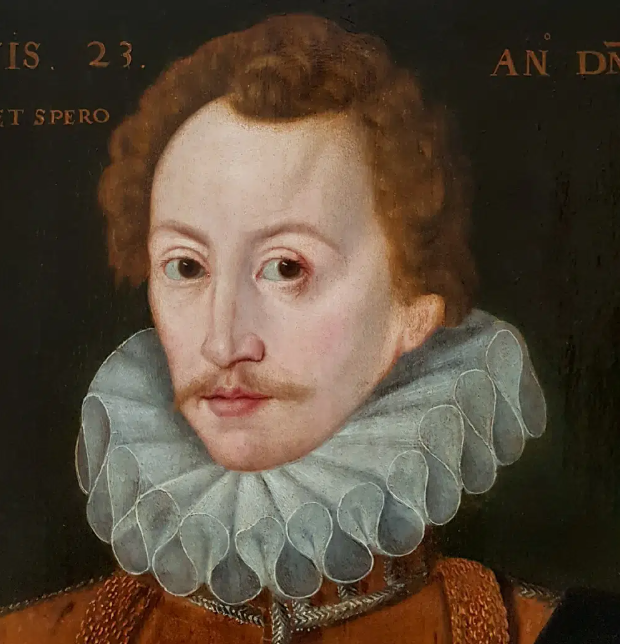
George Peele, an English playwright and poet of the late 16th century, is often noted for his contributions to Elizabethan drama. Born in London around 1556, Peele was educated at Christ’s Hospital and later at Broadgates Hall (now Pembroke College), Oxford, where he distinguished himself as a talented writer. His works include pastoral plays, pageants, and chronicle histories, reflecting a versatility that made him a notable figure in the theatrical world of his time.
Peele’s oeuvre includes notable works such as “The Arraignment of Paris” (1584), a mythological comedy that won him favor at court, and “The Battle of Alcazar” (circa 1588), a historical play that dramatizes the conflict between Portugal and Morocco. His “The Old Wives’ Tale” (1595) stands out as an early example of a fantasy play, replete with magical elements and a whimsical narrative structure.
One of the intriguing aspects of Peele’s literary career is the speculation about his connection to William Shakespeare. This potential link arises from several factors, primarily centered on stylistic similarities and collaborative works. Peele was part of the same vibrant theatrical milieu as Shakespeare, writing for the London stage during the late 1580s and 1590s, a period that saw the rise of Shakespeare’s own career.
Some scholars suggest that Peele might have collaborated with Shakespeare on certain plays. For instance, there are theories that Peele contributed to “Titus Andronicus,” one of Shakespeare’s early tragedies. The play’s mixture of brutal violence and lyrical passages has led some to posit that Peele, known for his flair for elaborate language and dramatic effect, had a hand in its creation. However, these claims remain speculative, with textual analysis yielding inconclusive evidence.
Further fueling the connection between Peele and Shakespeare is the play “Edward I,” attributed to Peele, which shares thematic and stylistic resemblances with Shakespeare’s history plays. Additionally, Peele’s work on pageants and masques for civic occasions in London might have intersected with Shakespeare’s involvement in similar events, providing a professional context for interaction.
Despite the speculative nature of their connection, Peele’s influence on the Elizabethan stage is undeniable. His ability to blend classical allusions, rich imagery, and compelling narratives resonated with the tastes of his time and possibly with his contemporaries, including Shakespeare. While the precise nature of Peele’s relationship with Shakespeare remains a subject of academic inquiry, it is clear that George Peele was a significant figure in the same creative landscape that nurtured the Bard, contributing to the rich tapestry of English Renaissance drama.
 Trail of the Green Man