
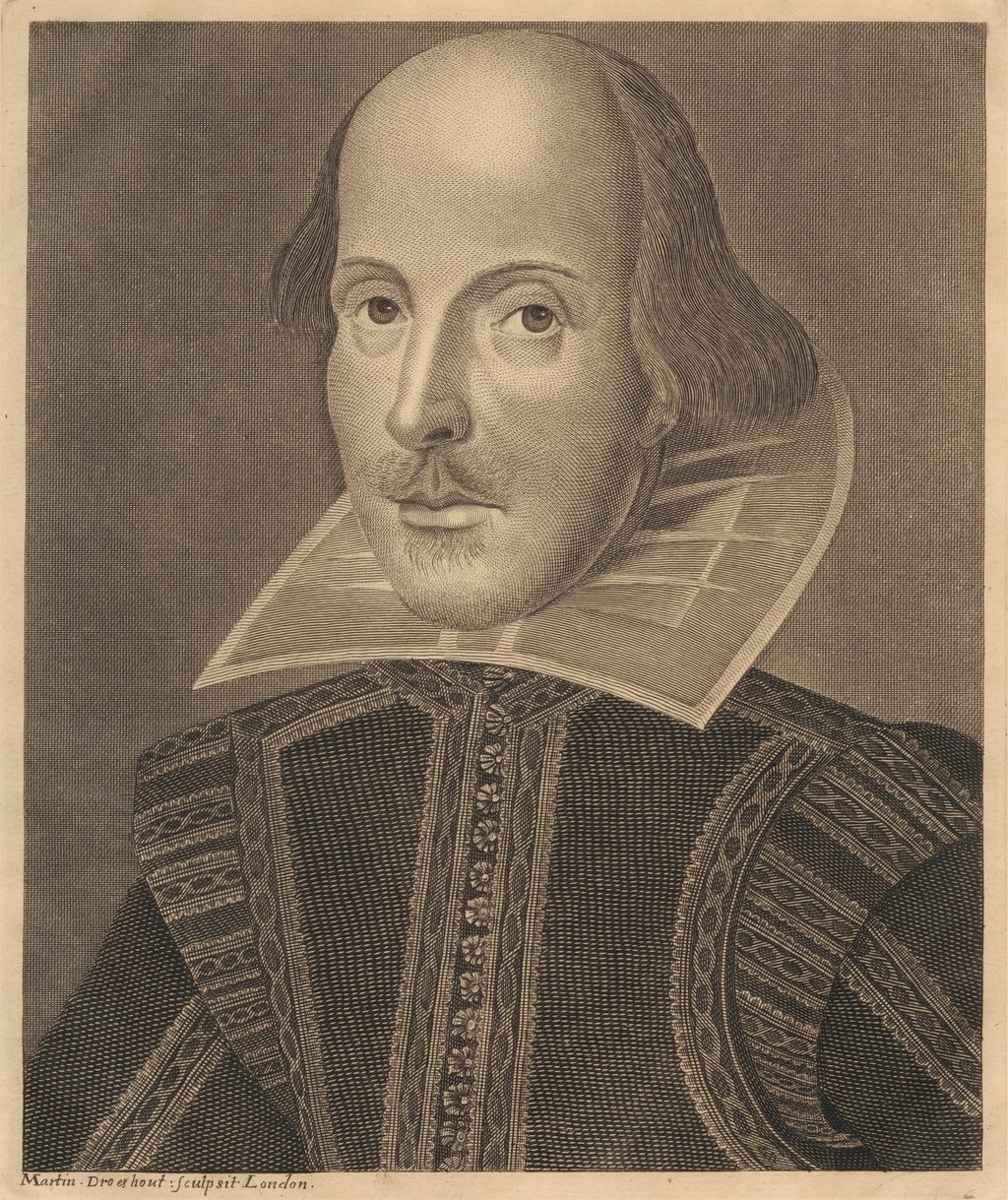
Known affectionately to many as simply The Bard, William Shakespeare was a renowned English poet, playwright and actor born in 1564 in Stratford-upon-Avon. He is often referred to as the greatest writer in the English language and the world’s pre-eminent dramatist who was known for his insight into human psychology, allowing him to create characters full of depth and nuance, and for his ability to weave contemporary ideas and socio-historical events into universal themes within his plays in a way that still has resonance today.
His works include 38 plays, 154 sonnets, and a variety of other literary pieces, including two narrative poems. Some of his most famous works include tragedies such as Macbeth, Hamlet and Othello, as well as romances like a Midsummer Night’s Dream, Much ado about Nothing and The Tempest.
The First Folio
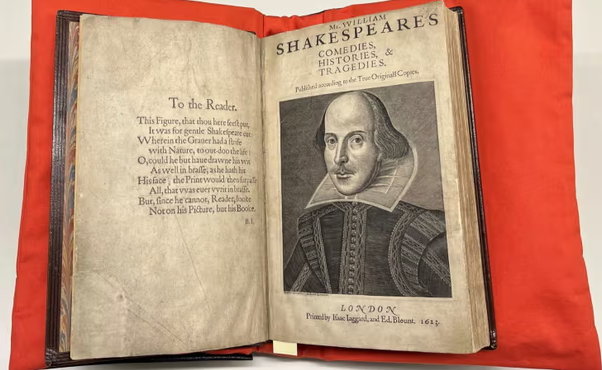
Despite his prolific output of work during his lifetime, Shakespeare’s plays were initially published independently, and the need for a comprehensive collection became evident.
Following Shakespeare’s death in 1616, two of his fellow actors and friends, John Heminges and Henry Condell, took on the monumental task of preserving his works for posterity. In 1623, seven years after Shakespeare’s demise, they oversaw the publication of the First Folio, officially titled Mr. William Shakespeare’s Comedies, Histories, & Tragedies.
The First Folio was not merely a compilation of Shakespeare’s works – it was a labour of love and a tribute to a literary giant. The folio contained 36 plays, including 18 that had never been published before, making it the most comprehensive collection of Shakespeare’s plays to date. Notably, some of his most famous plays, such as Macbeth, Twelfth Night, and Julius Caesar, might have been lost to time if not for the First Folio.
The First Folio was not just a collection of plays – it was a declaration of the cultural and artistic significance of Shakespeare’s work. The editors included a prefatory letter, expressing their admiration for their departed friend and the belief that his writings deserved to be preserved. The famous phrase: “To keep the memory of so worthy a friend and fellow alive as was our Shakespeare” encapsulates the reverence with which they approached the task.
The dedication to the First Folio is a poignant and poetic expression of the editors’ sentiments. In the dedicatory epistle, they refer to Shakespeare as the “Sweet Swan of Avon,” alluding to his birthplace on the banks of the river Avon. This evocative description reflects not only their admiration for Shakespeare’s poetic talents but also their desire to immortalize his memory. Yet for us the statement takes on a whole other meaning.
Alternative Authorship Theory
Despite the celebration of Shakespeare’s literary prowess, some scholars and enthusiasts have delved into the possibility of hidden codes and messages within his works or even questioned the true authorship. Theories suggesting that Shakespeare might not have been the sole author, or that his identity was a pseudonym for another writer, have circulated for centuries. The idea that hidden messages or cryptic clues exist within his texts adds an intriguing layer to the ongoing debate surrounding Shakespearean authorship.
Following clues and codes across Europe and London, enthusiasts and scholars alike have embarked on a quest to unravel the mysteries surrounding Shakespeare. Some theorists propose that concealed within Shakespeare’s writings are cryptographic puzzles or ciphers, waiting to be deciphered. While mainstream scholars largely dismiss these claims, proponents argue that the complexity and depth of Shakespeare’s works contain intentional codes, revealing alternative narratives or even the identity of the author.
Alternative theories continue to prevail about the true authorship of his work. Some think he was a front for Sir Francis Bacon, while others have speculated that he was a pseudonym for a collective of authors, including Sir Henry Neville, or even his good friend, Ben Johnson. We will examine some of these theories in more detail in a separate page/video.
The debate over secret codes and authorship mysteries adds an enigmatic layer to Shakespeare’s legacy. While the mainstream consensus supports the traditional understanding of Shakespeare as the singular genius behind his works, the allure of hidden meanings and alternative authorship theories continues to captivate the imaginations of those who seek to unravel the mysteries within the Bard’s timeless words.
KEY Themes in Shakespeare’s work
William Shakespeare and Humanism
In addition to exploring themes that were prominent during Elizabethan and Jacobean times, including utopianism, Shakespeare’s works often reflect the principles of Renaissance humanism. For one thing, his characters are often portrayed with striking psychological realism and depth, and his plots frequently emphasise key humanist ideals, such as the importance of self-knowledge, individual freedom, and the ability to reason, rather than simply take things on faith.
For another, his plays and poetry are notably secular, often focusing on human experiences and moral choices made for personal reasons, rather than religious ones. However, it’s important to note that while Shakespeare’s works reflect humanist ideals, it doesn’t necessarily mean that he was a humanist in the modern sense of the word. His characters often express superstitious and religious beliefs in phenomena such as divine intervention, the afterlife and supernatural entities (witches/magicians and ghosts feature in quite a few of his plays) which are not typically associated with humanism.
William Shakespeare and Puritanism
Shakespeare lived in an era when puritanism was a significant force in England, and he was clearly aware of puritanism and its influence. His plays often depicted Puritans, the most notable being the character Malvolio in Twelfth Night. However, these depictions were often critical, portraying puritans as zealous, pompous and hypocritical, so it seems unlikely that Shakespeare held any sort of puritan beliefs.
In fact, while officially a Protestant, there is ample evidence to suggest that he had family connections to Roman Catholicism, and may have been a secret papist himself. His mother’s family, the Ardens, were prominent recusants (those who refused to attend services of the state religion). Shakespeare’s father, John, was also fined for his recusancy in 1592 and chose to retire from politics rather than swear allegiance to the state religion.
However, this was a time when Catholicism was illegal and in order to work for the Crown as the head of the Globe theatre company and Kings Men actor’s troupe, he would have had to hide any Catholic sympathies he may have had in order to have a career.
In conclusion, while Shakespeare’s works reflect both Puritan and humanist influences, there’s no definitive evidence to suggest that he personally identified with either of these movements. His works remain a rich source of insight into the cultural and philosophical debates of his time.
Was Shakespeare a Rosicrucian or Freemason?
Theories that William Shakespeare may have been a Rosicrucian or a Freemason continue to intrigue. Most are based on interpretations of his works and the historical context in which he lived. Here are some reasons why people think this:
- Use of Occult and Rosicrucian Symbolism: Shakespeare’s use of the occult (ghosts, witches, magic, symbols, prophecies, astrology, etc.) pervades his plays and propels much of the action in some, such as in Hamlet (ghosts), Macbeth (witches), and The Tempest, which has a magician as one of its main characters. His familiarity with the symbolism of Rosicrucian and Freemason rituals suggests that these societies were sources of information.
- Baconian Theory: Some proponents of the Baconian theory of Shakespearean authorship, which contends that Sir Francis Bacon wrote the plays attributed to Shakespeare, argue that Bacon was a founding member of the Rosicrucians, or at the very least, sympathetic with their ideas. They believe that Bacon secretly created art, literature and drama, including the entire Shakespeare canon, before adding the symbols of the rose and cross to their work.
- Historical Context: The Rosicrucian movement was gaining momentum during Shakespeare’s time, and as a result, some believe that he may have been influenced by or involved with this group.
However, it’s important to note that these theories are speculative and lack definitive proof. While Shakespeare’s works do contain elements that can be interpreted as Rosicrucian, there is no concrete evidence to suggest that he was a member of the Rosicrucian order. As with many aspects of Shakespeare’s life and works, his potential ties to the Rosicrucians remain a subject of debate and interpretation
Freemasonry
Some believe that there are Masonic symbols and ideas woven into Shakespeare’s sonnets and plays. For instance, words like “apron,” “brother,” “compass,” “lodge,” “mason,” “square,” “master” and “worshipful” appear numerous times in his works. However, these could be coincidental as these words have common uses outside of Freemasonry as well.
In his book about Rosicrucianism, Tobias Churton quotes Julia Cleave’s paper “Burlesquing the Brotherhood,” delivered at Canonbury Masonic Research Centre’s International Conference in 2005, as possible evidence that the Bard my have been a freemason, or at the very least, been familiar with some of its terms and concepts. For example, Cleave claims that Shakespeare stuffed his play All’s Well That Ends Well, with what appear to be Masonic references—such as the verb cure, which is notably expressed as “raise.”
Others argue that there is no concrete evidence to suggest that Shakespeare was a Freemason. Freemasonry as a fraternity does not appear in his plays, and there is no indication that Shakespeare belonged to any one of the Time Immemorial Lodges.
In conclusion, while there are elements in Shakespeare’s works that can be interpreted as Masonic, there is no definitive proof that he was a Freemason or intentionally incorporated Masonic symbols into his works. It remains a fascinating area of speculation and interpretation, however.
 Trail of the Green Man