

In the annals of history, Dr John Dee (1527 – 1608) stands out as a figure of remarkable intellect and intrigue. Born in Mortlake, Surrey, this brilliant scholar, geographer, bibliophile and polymath would go on to become one of the most enigmatic and influential individuals of the Elizabethan era. Dee’s life unfolded against the backdrop of the Renaissance, and his multifaceted contributions spanned the realms of science, mathematics, mysticism, espionage, as well as extensive travels across Europe.
Dr John Dee’s journey through the corridors of power led him to encounter some of the most influential people of his time. His early education at St John’s College, Cambridge, marked the beginning of his intellectual pursuits. Whilst here, he also used his knowledge of chemistry to produce some stage effects for a production of Aristophanes’ play Peace. Given this connection to the theatre, it is perhaps rather fitting, then many believe he would become the inspiration for Prospero in William Shakespeare‘s play, The Tempest and Christopher Marlowe’s Dr Faust.
Dee’s voracious appetite for knowledge and his aptitude for the sciences brought him into contact with luminaries like Girolamo Cardano (whom he was believed to have met in London in around 1552/3), Gerardus Mercator and other leading minds of the Renaissance.
Dee’s penchant for the esoteric and the mysterious added an air of intrigue to his persona. Delving into alchemy, astrology, and Hermeticism, he sought to unlock the secrets of the universe. His collection of mystical manuscripts include annotated astrology textbooks by Cardano, as well as one of the first books on cryptography by the Abbott Trithemius, which he told Chief Minister and spymaster, William Cecil, he had obtained as a service to the nation.

The Queen’s Eyes & Ears
Beyond his scholarly pursuits, Dee found himself in the service of Queen Elizabeth I. His expertise in mathematics and navigation made him a valuable advisor, especially in the age of exploration when England sought to expand its global reach. Dee played a crucial role in recommending navigational routes and contributed significantly to the planning of overseas expeditions. He also used astrology to select an auspicious moment for her coronation after being appointed ‘Royal Advisor in mystic secrets’, i.e. Court Astrologer in 1564 – quite a turnaround from 1555 when he was imprisoned on charges of witchcraft and treason for casting the horoscopes of the young princesses Mary and Elizabeth.
Dee’s life took a clandestine turn as he became involved in espionage on behalf of Queen Elizabeth I. His skills in cryptology and codebreaking became assets in deciphering secret communications. For Dee, ciphers and codes were not just intellectual exercises; they were everyday occurrences, tools of the trade in his covert operations. Many believed he employed Cardan’s trellis cipher, as well as more complex codes such as the Ave Maria cipher, which he obtained from the the Abbott Trithemius’ Steganographia (1499) .
Like Francis Bacon and the Greek Platonists, Dee believed that numbers held the key to unlocking the secrets of the Universe, and like any curious scientist, he pursued any form of knowledge that might help him to gain mastery over the forces of nature. Many believed that this helps to explain his huge interest in antiquarian books and his varied interests in everything from science and geometry to alchemy and magic.
Dee & the Rosicrucians

One of the less explored facets of Dee’s life is his extensive travels across Europe. He wandered through the intellectual and cultural hubs of the continent, absorbing the knowledge and wisdom of diverse regions, making him more well-travelled and cosmopolitan than many of his contemporaries. His travels took him to cities such as Rome and Paris, where he encountered the intellectual ferment of the French Renaissance, Antwerp, Padua, Prague, Zurich, Venice and the courts of Central Europe, where he engaged with scholars and leaders, encountering the influential work of his European peers such as Cornelius Agrippa and the group responsible for producing the Rosicrucian manuscript trilogy. It is telling, perhaps, that the main sigil from his book, Monas Hieroglyphica (1564, Antwerp,), also appears in the 1459 edition of CR’s Chymical Wedding – so did Dee appropriate it from Johannes Andreae?
In his autobiography, the famous English astrologer, William Lilly, claims to have heard from a minister acquainted with an English merchant who’d lived in Germany, who told him that Dee had actually acquired his information from a friar who’d written a book that he claims Dee did not understand…Could Lilly’s ‘friar’ have actually been the Lutheran pastor, Johannes Valentin Andreae, suspected author of the Rosicrucian trilogy?
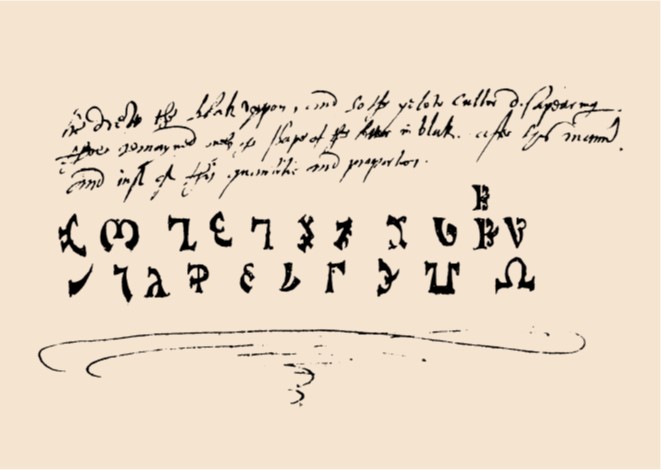
One thing is for certain – he does seems to have profoundly influenced by the work of many German occultists and religious authors. For example, his conversations with angels (1581-6, 1607) and ‘discovery’ of the Enochian alphabet seems to have been influenced by the work of the Abbot Trithemius (1462–1515). In 1499, he wrote to his friend, the Carmelite monk, Arnol Bostius, confessing that his discovery of steganography had been a divine revelation and that he believed the primary use of cryptography was to communicate with, and invoke God’s divine messengers, namely angels ( the term ‘angel’ derives from the Greek ‘angelos’ meaning ‘messenger’).
We also know that his scryer, Edward Kelley, knew the German Paracelsian alchemist, Carl Widemann (Wideman had been his secretary whilst in Europe), who in turn, was connected to Adam Haslmayr (ca. 1560–1630), the first know respondent to the Fama. All of which suggests that Dee likely had some form of contact, either directly/indirectly, with the work of the Tübingen circle during his time in Europe.
The Original 007?
As the centuries rolled by, Dr. John Dee’s legacy became shrouded in mystery. The man who walked the delicate line between scholarly pursuits, covert operations, and extensive travels now fascinates historians, cryptographers, and enthusiasts alike. The mystique surrounding Dee’s life, his contributions to cryptography, and his eclectic interests continue to captivate modern imaginations, leaving a legacy that transcends the boundaries of time.
An enduring example of Dee’s covert signature persists today—the renowned 007 emblem. At least according to author, Richard Deacon, who claimed in his 1968 book that Dee ‘signed his letters
to her with two circles guarded by what might have been a square root sign or an elongated seven.
Like this:’
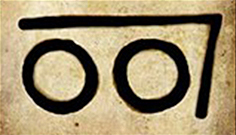
According to Deacon, the two zeros were meant to represent the two eyes of a spook or intelligence gatherer, whilst the number seven was a reference to the occult.
Seven, to Dee, was a sacred, a cabbalistic and a lucky numbcr.
Now ingrained in popular culture, synonymous with spies and intrigue, it’s conceivable that Dee strategically concealed elements in plain view. Could this seemingly modest signature hold the key to elucidating the enigmatic 7-sided tomb of the Rosie Cross or, at the very least, shed light on a portion of its meaning? Here, it is worth pausing to note that this story may well be part of an elaborate hoax, since no evidence has ever emerged of such a signature appearing in any of Dee’s actual letters to Queen Elizabeth I. Once again, Hermes the trickster calls on us to keep our wits about us, and our eyes wide open, as we traverse a path strewn with opinion and red herrings.
 Trail of the Green Man