
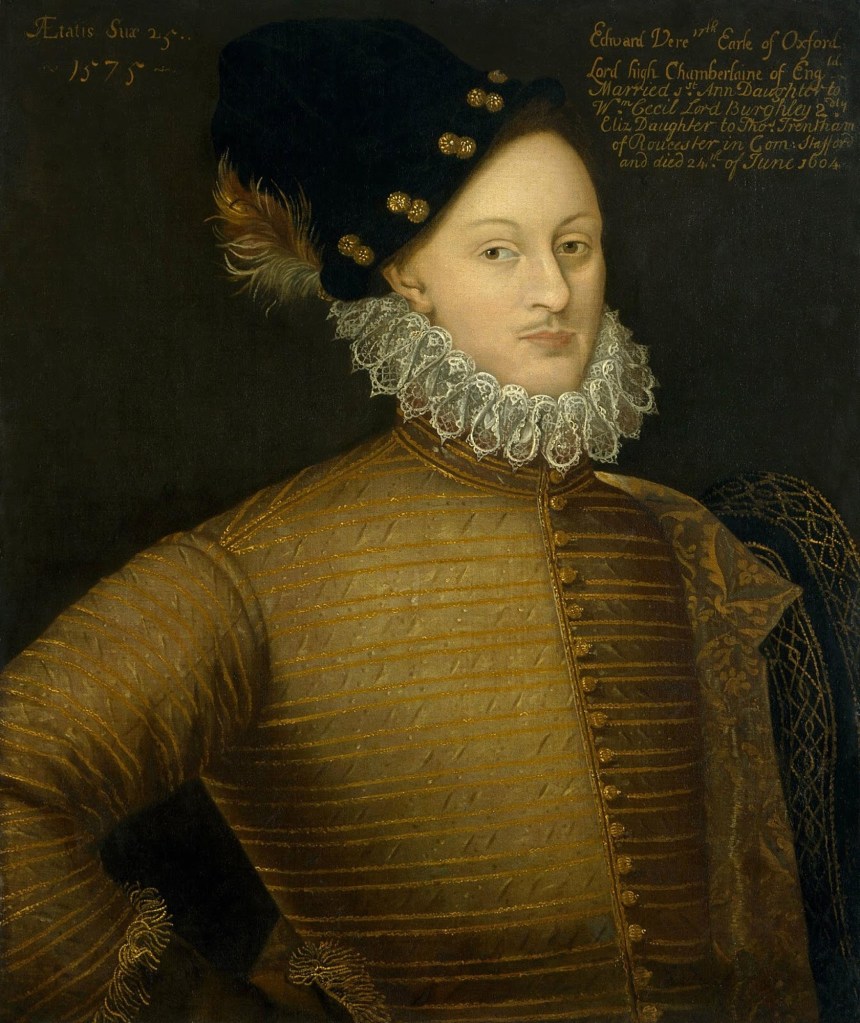
Edward de Vere, the 17th Earl of Oxford, was an English nobleman, courtier, and patron of the arts born on April 12, 1550. Known for his tumultuous life and literary inclinations, de Vere has been a subject of intrigue, particularly regarding the Shakespeare authorship question. As a well-educated aristocrat, he studied at Queens’ College, Cambridge, and later at Gray’s Inn, acquiring a reputation as a poet and playwright, although most of his works have not survived.
De Vere was a prominent figure at the court of Queen Elizabeth I, where his flamboyant personality and literary talents were well-recognized. His life was marked by extravagance, scandal, and controversy, including a period of estrangement from his wife, Anne Cecil, and financial difficulties despite his noble status.
The Shakespeare authorship debate, which questions whether William Shakespeare of Stratford-upon-Avon wrote the works attributed to him, has prominently featured Edward de Vere. Proponents of the Oxfordian theory argue that de Vere’s education, courtly experience, and literary skill make him a more plausible candidate. They cite supposed parallels between his life and the themes of Shakespeare’s plays and poems. However, mainstream scholarship continues to attribute the works to Shakespeare, with the debate remaining a fascinating aspect of literary history.
The question of who truly penned the Shakespeare Sonnets remains a tantalizing mystery. While William Shakespeare is conventionally credited as the author, some sceptics argue otherwise. The absence of concrete evidence directly linking Shakespeare to the Sonnets has led to speculation about alternative authors, including theories suggesting that the true writer concealed their identity behind a pseudonym.
The 1609 edition of the Sonnets boasts two distinct cover page dedications, each shrouded in ambiguity. The dedication to “Mr. W.H.” has spurred numerous theories about the mysterious recipient’s identity, ranging from an aristocrat to Shakespeare’s own literary alter ego. The second dedication, acknowledging the “only begetter,” adds another layer of intrigue. The dual dedications fuel ongoing debates about their intended meaning and purpose.
Numerous scholars and enthusiasts have explored the Sonnets for hidden codes and messages, drawing connections to the enigmatic Rosicrucian’s. This secretive and mystical order, rumoured to possess esoteric knowledge, has been linked to the Sonnets through interpretations of symbols, wordplay, and numerical patterns. Some theories suggest that the Sonnets may contain veiled instructions or messages left by the Rosicrucian’s, adding an esoteric layer to the already rich tapestry of the poems.
The intricate structure and ambiguous language of the Sonnets invite diverse Interpretations. Various theories propose hidden meanings related to alchemy, astrology, and even political allegiances. Some argue that the sequence follows a deliberate order, offering clues to unravelling a deeper narrative. The speculative nature of these interpretations has sparked ongoing fascination and debate within literary circles.
In essence, the Shakespeare Sonnets persist as a literary enigma, inviting scholars, cryptographers, and enthusiasts to unravel their secrets. The persistent mysteries surrounding authorship, dedications, and potential hidden messages continue to make the Sonnets a captivating subject for exploration, ensuring that the allure of Shakespeare’s enigmatic verses endures through the centuries.
 Trail of the Green Man