

Ben Jonson (1572–1637) (or Johnstone, as it is sometimes spelled) was an English playwright and poet. He is generally regarded as the second most important English dramatist after William Shakespeare during the reign of King James I. Jonson’s artistry exerted a lasting influence on English poetry and stage comedy.
He is best known for his satirical plays such as:
- Every Man in His Humour (1598)
- Volpone, or The Fox (c. 1606)
- The Alchemist (1610)
- Bartholomew Fair (1614)
He also wrote lyric and epigrammatic poetry.
Many scholars describe Johnson as a classically educated, well-read and cultured man of the English Renaissance with an appetite for controversy whose cultural influence was of unparalleled breadth upon the playwrights and the poets of the Jacobean era (1603–1625) and of the Caroline era (1625–1642).
Like William Alexander, Jonson’s family was of Scottish descent – his father was a protestant clergymen, giving him a link to the many Huguenots, puritans and protestant utopians we find involved in this story.
Jonson was educated at Westminster School at the expense of one of the masters there and may later have attended St John’s College, Cambridge. However, we do know that he briefly went into trade as a bricklayer for a short time (his stepfather’s occupation) and also fought in Flanders with the English army before finally becoming a playwright.
Like Hermes-Mercury the trickster, the planetary ruler of his Gemini sun sign, his name remains something of a puzzle. While the playwright’s ancestors originally spelled their family name with a letter “t” (Johnstone or Johnstoun), over time, the spelling evolved to the more common “Johnson.” It is said however, that Ben Jonson preferred the spelling of “Jonson.”
He became poet laureate in 1619 and unusually, is also the only person buried in an upright position in an area known as Poet’s Corner within Westminster Abbey.
The First Folio
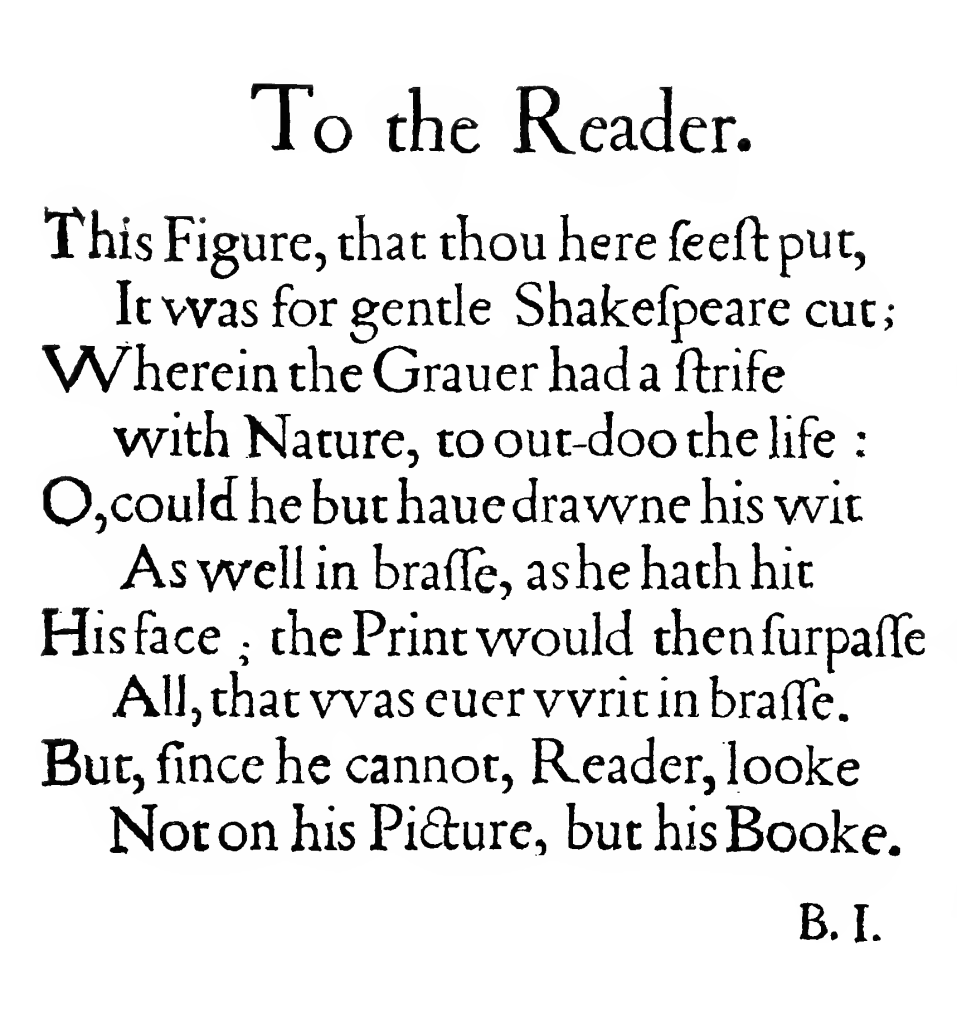
Ben Jonson played a significant role in the publication of the First Folio of William Shakespeare’s plays in 1623. He wrote a famous preface to the First Folio, titled “To the Reader.” In this preface, Jonson wrote about the engraved portrait of Shakespeare on the title page, advising the reader to “look, not on his picture, but his book.” One might argue that this emphasis on ‘the work’ (ergon) and not the personality, is a very alchemical and Rosicrucian orientation.
Countless researchers have delved into this enigmatic verse, looking for codes and ciphers that might help solve the mystery of whether Shakespeare was really the sole author of these works, or if he was part of a duo, or even a front for someone else who wished to remain anonymous like Francis Bacon.
It is also worth noting that Jonson himself had previously published his own works in a folio format, setting a precedent for other playwrights, including Shakespeare. His collection, The Workes of Benjamin Jonson, was published in 1616.
However, it’s fair to say that the First Folio was a collective effort, produced by John Heminge and Henry Condell, two of Shakespeare’s fellow actors who assembled the plays as a tribute to their late colleague. Many also forget how important the role of the syndicate of printers were in this whole project – something that the Oxford academic and author, Ben Higgins, has attempted to rectify with his book, Shakespeare’s Syndicate.
Higgins identifies the ‘syndicate’ as:
- William and Isaac Jaggard
- Edward Blount,
- John (Master) Smethwick, and
- William Aspley.
Higgins argues that it is important to remember that these stationers were not just printers but also publishers and booksellers, and that the previous record of works printed and sold/distributed by these printers would have added a note of gravitas to Shakespeare’s work, giving the First Folio an extra layer of literary authority – a factor that tends to be forgotten nowadays.
So, while Jonson was not solely or directly responsible for the publication of the First Folio, his influence and contribution were certainly significant. His preface and his own folio publication helped shape the way Shakespeare’s works were presented and perceived.
 Trail of the Green Man