
The Pen is Mightier than the Sword…
Much like the internet, which helped to accelerate the democratisation of knowledge, the printing press performed a similar function in Europe from the mid-15th century onwards, helping to spread ideas beyond the walls of universities, cloisters and the salons of wealthy, educated individuals to ordinary people. Now anyone who could read or write had the potential to change – and be changed by – the written word. This technological leap not only helped to spark the Renaissance, but also to accelerate religious revolutions such as the Reformation.
Once it became easy to churn out works in large numbers it was harder for anyone to control the thoughts of the people.
Great British Life on William Caxton
Contrary to popular belief, many of the purveyors of this brand new technology were well-educated, cosmopolitan and well-travelled. Some, especially in Europe, had been former lawyers or merchants with their own businesses who either decided to change profession, or were protestant refugees like the Huguenots who had been forced to flee their homes in France due to religious persecution, and start over, either in another protestant-friendly European enclave like Geneva, or England.
Over time, they had developed their own ideas about society, politics, economic policy and so forth, which they wished to convey via the new and influential medium of the printed word. Aside from writers, and wealthy patrons, who might pay for a certain text to be printed for ideological reasons, many printers also themselves saw themselves as influencers and propagandists. Some saw it as their duty to evangelise or ‘spread the word’ about important causes and so used their printing presses to publish material that was in line with their own social, religious or political views, much like social activists or religious evangelicals might use social media today.
William Caxton (1422-1490)

For example, William Caxton, who brought the printing press to England, was a former wool and textile merchant who became interested in Continental politics due to his connections and business involvements with influential figures in the so-called Low Countries – he even lived in Bruges for a while, where, from 1462 to 1470, he served as the governor of the ‘English Nation’ on behalf of his fellow ‘Merchant Adventurers’. This position allowed him to represent his trade and act as a diplomat for the king. It is here that he also learned the art of printing, later bringing this new technology to England. When he opened up his print shop in Westminster, many of Caxton’s patrons and clients were wealthy and influential people, from kings like King Edward IV and Henry VII, to nobility such as the Duchess of Richmond, Earl Rivers, and the Earl of Arundel. Caxton also had diplomatic ties with Burgundy and the Hanseatic League and, by 1471, had ingratiated himself into the household of Margaret of Burgundy, sister of England’s Yorkist king, Edward IV.
Fluent in several languages, including French and Dutch, Caxton spent a lot of time translating European texts into English. In fact, Caxton’s chief objective in getting involved in the printing business was to:
…save himself the labour and weariness of copying by hand the various works which he translated for the pleasure of others. He recognized that by the art of printing copies could be multiplied easily and quickly: that they would be easier to read than manuscript, and, provided that type, ink and paper were of good quality, would endure indefinitely. Caxton’s concern was to make his countrymen acquainted with the best literature—books of literary value, that would please readers, not by their prettiness, but for the matter that was in them.
English Printer’s Ornaments by Henry R. Plomer
And indeed, when he came to England, he spent a lot of time publishing local authors and poets, including some of the very first editions of Chaucer’s The Canterbury Tales. This was an era in which ‘the functions of publisher and printer were often largely (though not entirely) separate’. It is also worth remembering that many were family-run businesses that were passed down from one generation to the next, many of whom took on apprentices who then sometimes took over the business when the master retired, or else went to set up their own businesses, many of which were in a similar part of town. In London, for example, many printers initially set up shop near St Paul’s Cathedral (a hangover from their days as illuminated manuscript stationers) before all moving to Fleet Street, which would later became a hub for the newspaper business. As such, many knew each other, and over time developed a good instinct for what sort of material would sell, and would use their professional and familial networks to distribute material far and wide.
THE PROTESTANT CONNECTION
In his dissertation on Huguenot printers in Europe, Byron Hartfield writes that:
The educated urban elite fought on the battlefield of public opinion, and their weapon was the printing press. Europe was undergoing a communications revolution as print became ubiquitous. This “print revolution” fed the war of ideas in Reformation Europe and was in turn fed by it, creating a sort of positive feedback loop which contributed both to the spread of print and to the polarization of confessional identities in Europe. Nowhere was this more evident than in Geneva, where the explosive growth of the print industry was fed by a constant influx of talented and ambitious Protestant immigrants.
Hartsfield, Byron J., “Changing Narratives of Martyrdom in the Works of Huguenot Printers During the Wars of Religion.” (2018).
Certainly, in Reformation Europe, especially in places like Geneva, a city-state that in 1541 became a Protestant Republic and considered itself the Protestant rival to Rome, many Huguenot and Calvinist printers began producing work that either explicitly or implicitly aimed to evangelise a more humanist and/or protestant-friendly message to readers as a counter to the dominant narratives of the day.
A good few of Geneva’s religious refugees came from France, especially Paris (including John Calvin himself, who set up his base of operations here), as well as north-east France, French Picardy and the French-speaking parts of the Spanish Netherlands like Arras. Although some came from a printing background, others were simply entrepreneurs who understood the importance of forming professional and social networks that enabled them to succeed.
Many of these protestant printers were also sympathetic to the work of authors whose ideas and convictions might be considered ‘heretical’ and would therefore be more open to printing ‘banned’ material that others who were perhaps trying to ingratiate themselves with patrons who were establishment figures. Often, scholars and writers of these types of works would meet twice a year at the Frankfurt Book Fair, which from 1462 until 1764, became THE place in Europe to sell and distribute books, as well as network with other writers and printers. Many important manuscripts became bestsellers as a result of distribution and licensing deals done in Frankfurt.
Eustache Vignon & Jean Crespin

Eustace Vignon was a Huguenot printer originally from Arras, who ended up who running a printing company with his business partner and father-in-law, Jean Crespin, who he met at the Frankfurt book fair.
Descended from a family of wealthy bankers in Arras (part of the Spanish Netherlands) and the son of a lawyer, Crespin had obtained a university degree before moving to Paris, where he became part of a network of young humanists attracted to reformist ideas, ultimately becoming a committed Calvinist. However, after being forced to move several times around France due to religious conflict and persecution, he eventually settled in Geneva where he began writing and using his printworks as a way to propagate humanistic and protestant ideas to a wider audience. In addition to publishing many works for Calvin and other notable Calvinist scholars, he also wrote a series of so-called ‘martyologies’ – an assortment of journalistic accounts of various historical events involving persecuted peoples, with the aim of indirectly criticising the imperialism and colonialism of Catholic countries such as France and Spain.
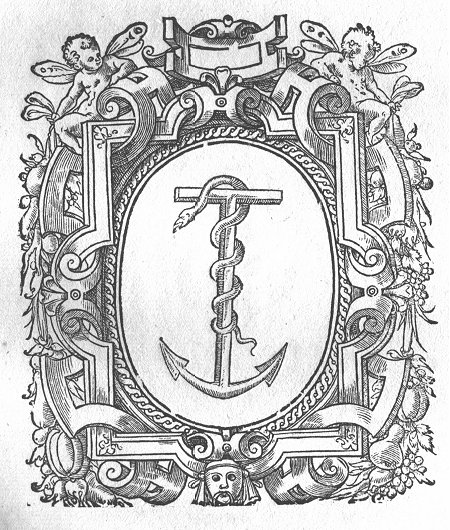
Vignon, his son-in-law and successor (and an important figure in the Green Man story) was a cosmopolitan figure, who spoke several languages and networked all over central Europe, including France, Germany and the Netherlands. He had converted to Calvinism while working in Antwerp, and like his well-educated middle class father-in-law, was interested in the issues and currents affairs of the day. These interests varied from the Reformations and Wars of Religion; to the discovery and colonisation of Americas; the Enlightenment and new attitudes towards science; the development of the modern nation-state; and, not least, the potential influence of mass media, fomented by the Print Revolution, to shape and change society for the better.
After relocating to Geneva, Vignon invested in Crespin’s print firm and became a junior partner. He
lived in Crespin’s house, becoming a part of the older man’s household – a part of the “family.” Both saw themselves as social activists who knew John Calvin personally and were keen to try and evangelise the protestant message to a European public who they saw as desperately in need of liberating from the oppressive grip of the Catholic Church. Together, they used their printing and publishing house to try and make an impact on European attitudes towards religion and society, encouraging a less sectarian, more universal form of Christianity based on a tolerance and altruism, and encouraged greater freedom of expression and thought when it came to interpreting history.
During the Age of Discovery, they were also responsible for generating increased interest in travel literature, especially places such as the New World, which sometimes took on a utopian quality not unlike that seen in the work of Francis Bacon. As we will see, this becomes important when considering the reasons why groups of settlers such as the Puritans and the Acadians chose to emigrate to Canada and America to establish their own version of Arcadia, away from the horrors and persecution of the Thirty Year’s War and the Great Persecution in Restoration England.
As exiles from the French-speaking part of the Spanish Netherlands, both men, like many Huguenot refugees elsewhere, also made extensive use of their networking skills to establish themselves as respectable businessmen in their new home cities, and to extend their influence via familial and values-based networks, further afield.
This makes them important to study, especially in light of the Green Man trail, where one printing block could start in Amsterdam or Frankfurt and end up in England. By tracing their inter-personal connections, life stories and religious affiliations, one can often unpick how and why these moves occurred – a allow patterns of distribution to emerge that might otherwise remain hidden, or seem illogical.
In summary then:
The Huguenot printers of sixteenth-century Geneva claimed identities that were shockingly new. They practiced a profession that had not existed a century earlier and a religion that they were still in the process of forming, in a city that until their own time had little influence outside its immediate surroundings. These printers changed their world. They helped to create the Reformed faith and change the face of the Christian religion. They also laid the ground for a new idea of morality, a universal morality based on kindness and tolerance.
Hartsfield, Byron J., “Changing Narratives of Martyrdom in the Works of Huguenot Printers During the Wars of Religion.” (2018).
ENGLISH REBELS & PROFESSIONAL BROTHERHOODS
In Europe, many printing businesses were family affairs, with the business and trade being passed on from father to son, this sense of community being continually fed via ties made through marriage and godparentage. Trade fairs also became important regular meeting hubs for the intellectuals, writers and printers of Europe to network and exchange ideas.
In England, however, things were slightly different. Although printing businesses were often run by families and passed from one generation to the next, additional ties tended to be formed via apprenticeships and membership of professional associations like livery companies, as well as business connections formed between printers and booksellers. Indeed, many print-runs were commissioned directly by bookshop owners, who got requests from their clients and developed a taste and feel for what would sell.
As a result of both types of networking, it soon became clear to the intelligentsia that books provided an important medium, not just for educating minds and improving knowledge, but also for shaping society. And it wasn’t just exoteric, overtly political or evangelical groups that realised this. Enter secret affiliations and hidden fraternities, who not only used books to communicate their heretical ideas in coded format so as to escape censorship, but also clearly had some allies within the printing profession.
Valentine Simmes
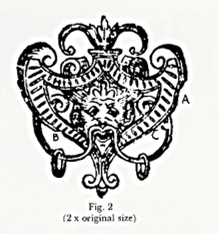
A London-based an Elizabethan era and Jacobean era printer, Valentine Simmes (or Symmes as it sometimes spelled) became known for printing religious and historical works as well as plays, including the works of Shakespeare. Operating from premises “on Adling Hill near Bainard’s Castle at the sign of the White Swan,” he was thought to be a fairly good printer, although most of his type was said to consist mostly of black pica second-hand letters. We know, for instance, that his press as confiscated several times, and that at some point, he acquired equipment from William How, a copper-plate printer, ‘as evidenced by the identifying details of How’s printing equipment.’
A summary of his printing career shows that Simmes (or Symmes) had a penchant for getting into hot water. From the very outset of his career (which began in around 1585 in London after his eight year apprenticeship with the bookseller, Henry Sutton, ended) he was constantly in trouble for printing books that were ‘obnoxious to the authorities, or were the property of other men.’ At one point, he was even thrown into jail for being a member of the Martin Marprelate printers, a group of Puritans using a secret press to produce a series of anti-papal pamphlets written under the pseudonym, Martin Marprelate, gentleman.
A full list of his ‘crimes’ proves rather enlightening in terms of his sympathies and inclinations:
- In 1589, he was arrested as one of the compositors of the press that produced the Marprelate tracts, and spent five months in prison.
- In 1595, he was caught printing the a text copyrighted to someone else, and his press was seized, his type melted and he was compelled to transfer his apprenticeship to James Roberts, and forbidden to take another until that one was out of his time.
- In 1599, he was named in a list of fourteen printers who were strictly forbidden to print satires or epigrams, and was fined a shilling, perhaps in connection with the same matter.
- On another occasion he was caught printing a ballad against Sir WaIter Raleigh, when it is said Bishop Bancroft warned the printer that he could have hanged him long before, if he had wished to do so.
- In 1622, he was prohibited by the order of the High Commissioners from working as a master printer and was forced to retire, receiving a pension of £4 a year from the Company of Stationers.
Some other controversial religious material that he printed included the first and second parts of the controversial biblical text, King Solomon’s Song of Songs, a Scripture which according to the Preface, is ‘extreamely flowted of our Machinillaines, Sernetians, and carnal Humorists,’ no doubt because of its sexual undertones. However, the author/translator, a preacher from London named Henlon Clapham, makes it clear in his introduction to Part 1 that after ‘six and twenty sermons’ on the subject, his chief purpose was to emphasise the underlying spiritual message of this text and not to provide the public with salacious material under a religious guise.
Notice the rosy crown he uses as his printer’s mark on the first part, printed in 1602 (below left). By the time we get to the second and third parts (1603), he seems to have switched up his insignia to that of the Green Man (below right). According to the biographer Craig Ferguson, Simmes generally used three different insignias: two with naked children (cupids?) on them and one with a large leaf design (green man, which he refers to as McK 379 due to a previous study in another publication). However, it is clear from Ferguson that Simmes had at least 11 different ornaments, some of which were acquired by other printers such as Henry Ballard when he got into trouble and was forced to sell his equipment, or went out of business.


Given his choice of insignia and his chequered history, Simmes may have been ideologically driven in terms of the type of work he was producing. However, it is not known whether he was a Puritan or had any Rosicrucian affiliations.
We do know he worked regularly the following booksellers:
- Publisher Andrew Wise where he worked on Richard II, Richard III, Henry IV, and Much Ado about Nothing (Rasmussen).
- Nicholas Ling, printing twenty-seven books for him. This makes up about 1/3 of Ling’s publishing credit. Ling was also apprenticed to Henry Bynneman (after Sutton) from 1570-1579, crossing over with the time that Simmes trained with Bynneman. It is very likely that the two met each other at Bynneman’s shop.
FURTHER READING:
- A short biography of Valentine Simmes
- London Book Trades entry, which includes his previous addresses and Stationer’s Guild History
 Trail of the Green Man